


Every Size, Not Just Large Corporations
A five-person crypto startup issuing tokens under MiCA needs an LEI just like a large exchange does. Startups, SMEs, mid-market companies and large corporations are all in scope, regardless of size.

Select Your Jurisdiction
Currently selected: Cayman Islands|

Search region…
Every cross-border transfer, instant payment and CHAPS transaction now runs through the same question: who, exactly, is on the other end? Payment service providers, banks and fintechs are required to answer it with a verified entity identifier, not a name that might be spelled three different ways across three different systems. The Legal Entity Identifier answers it once, consistently, everywhere. LEI System gets you one in minutes, backed by GLEIF accreditation and a 150-jurisdiction reach.


LEI System is an official LEI Registration Agent
Latest LEIs issued:
984500F4100AB5956011 |  QUINNCOM INTERNATIONAL PTY LTD
The requirement reaches further than banks alone, most legal entities touching a payment chain now need to be identifiable the same way, and relevance has nothing to do with company size.
A five-person crypto startup issuing tokens under MiCA needs an LEI just like a large exchange does. Startups, SMEs, mid-market companies and large corporations are all in scope, regardless of size.
PSPs, correspondent banks and payment institutions use the LEI to identify themselves and every counterparty across CHAPS, SWIFT and instant-payment rails, satisfying FATF and national mandates in one identifier.
Companies sending or receiving high volumes of B2B payments increasingly need an LEI on file, both to satisfy their bank's Verification of Payee checks and to be found reliably by counterparties doing due diligence before a transfer.
CASPs processing transfers under the EU Transfer of Funds Regulation (2023/1113, Article 4) must identify legal entity originators and beneficiaries with an LEI where one is available.
Platforms embedding payment rails into their own product, embedded finance, BaaS, marketplace payouts, use the LEI to identify the legal entities behind every account they onboard, often at volume.
Regulation is the reason to register. These are the operational problems it solves along the way.
| Problem | How the LEI Solves It |
|---|---|
| A payee name can be spelled three different ways across three systems | One code resolves to one entity record, no fuzzy name-matching required |
| Vendor scams rely on near-identical company names to redirect payments | Verification of Payee becomes an exact LEI + IBAN match, not an approximate one |
| Sanctions screening flags legitimate transactions due to name variants | A standardized identifier removes the ambiguity screening systems misread as risk |
| Cross-border transfers stall on manual entity verification | Originator and beneficiary are identified automatically, without a manual review step |
| Onboarding a new corporate payee takes days of registry lookups | One LEI lookup returns verified legal name, address and status instantly |
Beyond satisfying a regulation, this is where the LEI actually gets used day to day.
Before releasing a high-value or cross-border payment, confirm the beneficiary's LEI carries ISSUED status and matches the account holder on file.
Pair a payee's LEI with their IBAN to run an exact-match check, the standard now required for eurozone instant transfers.
Onboard a new correspondent bank or payment partner with a quick LEI company search to confirm legal name, jurisdiction and regulatory status in one step.
Screen counterparties against sanctions lists using their LEI rather than a free-text name, cutting false positives caused by naming variants.
Populate the structured party-identification fields in ISO 20022 payment messages directly with LEI codes, satisfying CHAPS and equivalent mandates.
Report counterparties in FATF-aligned and national payment-transparency filings using their LEI as the standard reference identifier.
Before the LEI, verifying a legal entity payee meant matching names across registries that don't agree with each other.
“Acme Ltd,” “Acme Limited,” and “ACME LTD” might be the same company, or might not be, and a payment processor has milliseconds to decide. That ambiguity is exactly what enables misdirected payments and vendor fraud to slip through.
The LEI closes the gap: one code, one entity, verifiable against a single global index in real time, no name-matching guesswork required.
Regulatory compliance is the reason payment providers register an LEI. What it changes operationally is the reason it's worth doing properly.
Regulatory compliance is the reason payment providers register an LEI. What it changes operationally is the reason it's worth doing properly.
Pairing an LEI with an IBAN gives a payment provider a trusted anchor: one validated identifier tied to one verified account. LEI validation against GLEIF's registry, rather than an approximate name match, is what closes the exact gap vendor-scam fraud exploits, catching mismatches and near-miss name variants before funds move.
A verified LEI lets originator and beneficiary entities be identified precisely and automatically across borders, without a manual compliance review stalling the transaction. The Financial Stability Board's 2024 report on cross-border payments names broader LEI adoption as one of the concrete steps toward the G20's cross-border payments targets.
Screening systems built on inconsistent entity names generate noise: legitimate transactions flagged because “Acme Ltd” didn't match “Acme Limited” cleanly. A single, standardized identifier removes that ambiguity at the source.
Every additional manual step in a payment chain is another chance for a name to get re-typed slightly wrong. A machine-readable identifier that travels with the transaction removes that failure point entirely.
Four separate regulatory tracks have converged on the same answer, which is part of why LEI compliance in payments isn't a passing trend.
The Financial Action Task Force's June 2025 update to Recommendation 16 requires payment messages to carry accurate originator and beneficiary information, with every entity in the chain accountable for it.
CHAPS Direct Participants have been required to include LEIs in payments under defined criteria since May 2025, with the Bank of England's confirmed policy expanding mandatory enhanced data, including LEI, across all Direct Participant channels from November 2027.
Since October 2025, every eurozone payment service provider must verify a payee's name against their IBAN before processing an instant transfer, a check the LEI turns into an exact match.
For crypto-asset service providers, TFR Article 4 requires the LEI for legal entity originators and beneficiaries in every CASP-to-CASP transfer, where the payer has provided one and the message format supports the field, with no minimum transfer threshold.
| Regulation | Jurisdiction | What It Requires |
|---|---|---|
| FATF Rec. 16 & 24 | Global | Verified originator/beneficiary ID and beneficial ownership data |
| EU Instant Payments Regulation | Eurozone | Payee identity verification before instant transfers |
| Bank of England CHAPS | UK | LEI in ISO 20022 payment messages, mandatory since May 2025 |
| Transfer of Funds Regulation | EU | LEI for legal entity originators in CASP-to-CASP transfers |
| RBI Circular | India | LEI for large-value transactions above ₹5 crore |
| Financial Data Transparency Act (FDTA) | USA | Joint rule (effective Oct 1, 2026) adopts the LEI as the standard entity identifier across 9 federal regulators, including banks and credit unions; agencies have up to 2 years to incorporate it into their own reporting rules. |
Individual registration works when you need one LEI. Payment providers rarely stop at one, merchant portfolios, correspondent banks and payee lists all need identifiers tracked at once.
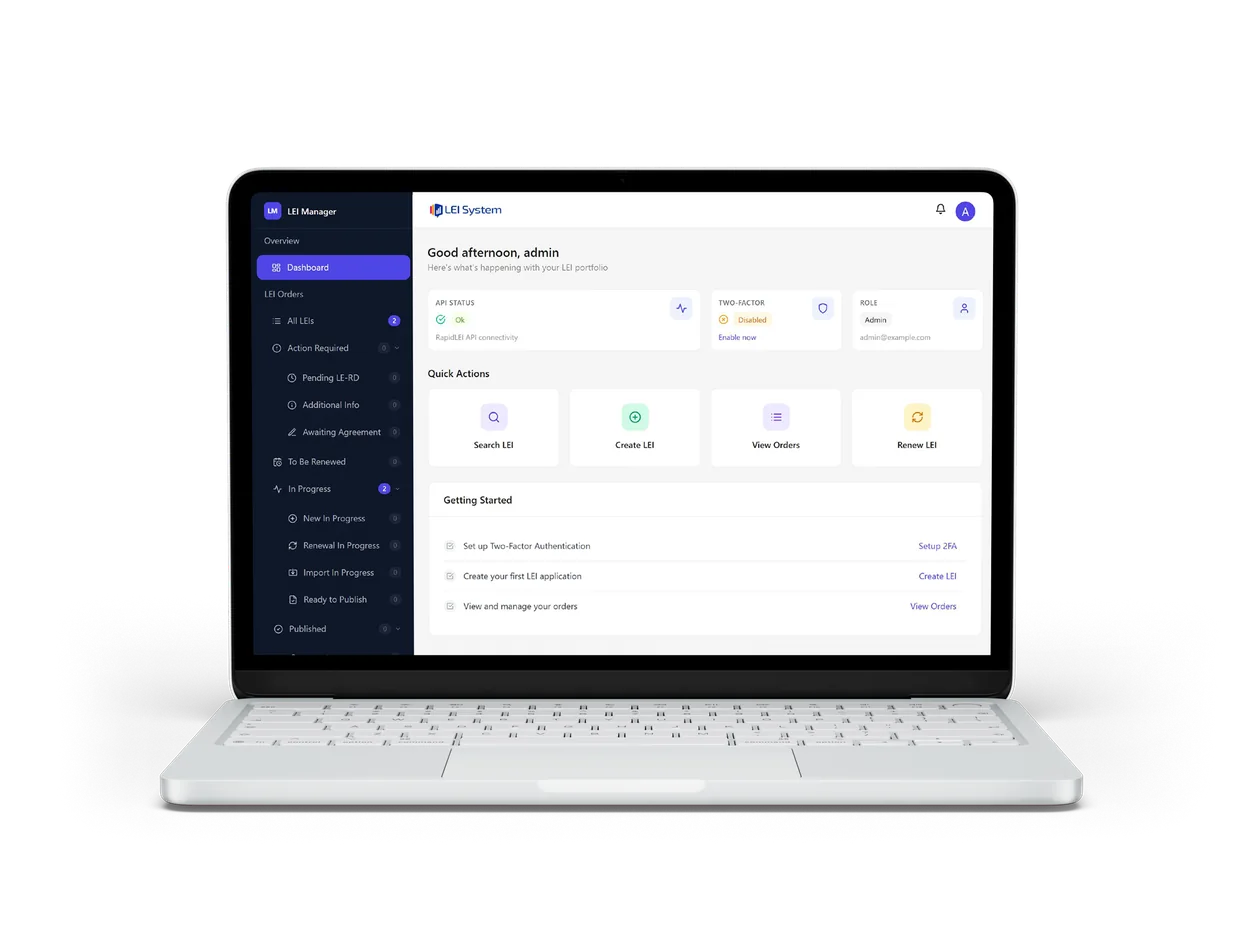
LEI Manager is LEI System's platform for exactly that.
Explore LEI ManagerTrack every LEI you're responsible for, your own entity, correspondent banks, merchant payees, from one dashboard, with automatic renewal so a payee's code never lapses mid-relationship.
Connect LEI registration, lookup and status checks directly into your onboarding or transaction-processing systems via the LEI Manager API, so entity verification happens automatically, not as a manual side process.
Register up to 200 payee or merchant entities in a single upload instead of repeating the application 200 times, LEI Manager verifies each one against official registries and issues codes without separate validation delays.
Getting registered is a five-minute online process, not a paperwork exercise. Submit your entity's legal name and registration details, LEI System verifies them against official business registries, and your code is issued and published to the GLEIF Global LEI Index, immediately checkable by any counterparty or regulator who looks it up.

Pick a subscription plan and complete the online application with your entity's legal name, address and registration number.


Our system verifies your entity data against official business registries in real time, notifying if additional documents are needed.

Your LEI code is issued, recorded in the Global LEI Index and delivered to your email address along with a confirmation.
Every LEI System plan includes the GLEIF fee, lapse protection, and automatic annual renewal, so a code stays in ISSUED status for every transaction it is used in, not just the first one.

Kristian Hein, November 18
The Financial Stability Board’s 2026 cross-border payments report highlights the UK’s CHAPS system as a live example of how Legal Entity Identifiers are moving into payment infrastructure. CHAPS handles everything from time-sensitive business and property payments to large financial-market settlements. Its financial-institution layer carries 73% of the value settled, making LEI data especially relevant for risk management, compliance, counterparty identification, and automated processing.
Read more
Kristian Hein, November 11
Does a branch need its own LEI, or should it use the head office’s code? Opening a foreign branch does not automatically create a separate LEI requirement. This guide explains the difference between branches and subsidiaries, when reporting rules call for the head office’s LEI, and when a branch may need its own. Find out what to check with your bank, broker or supervisory authority before applying.
Read more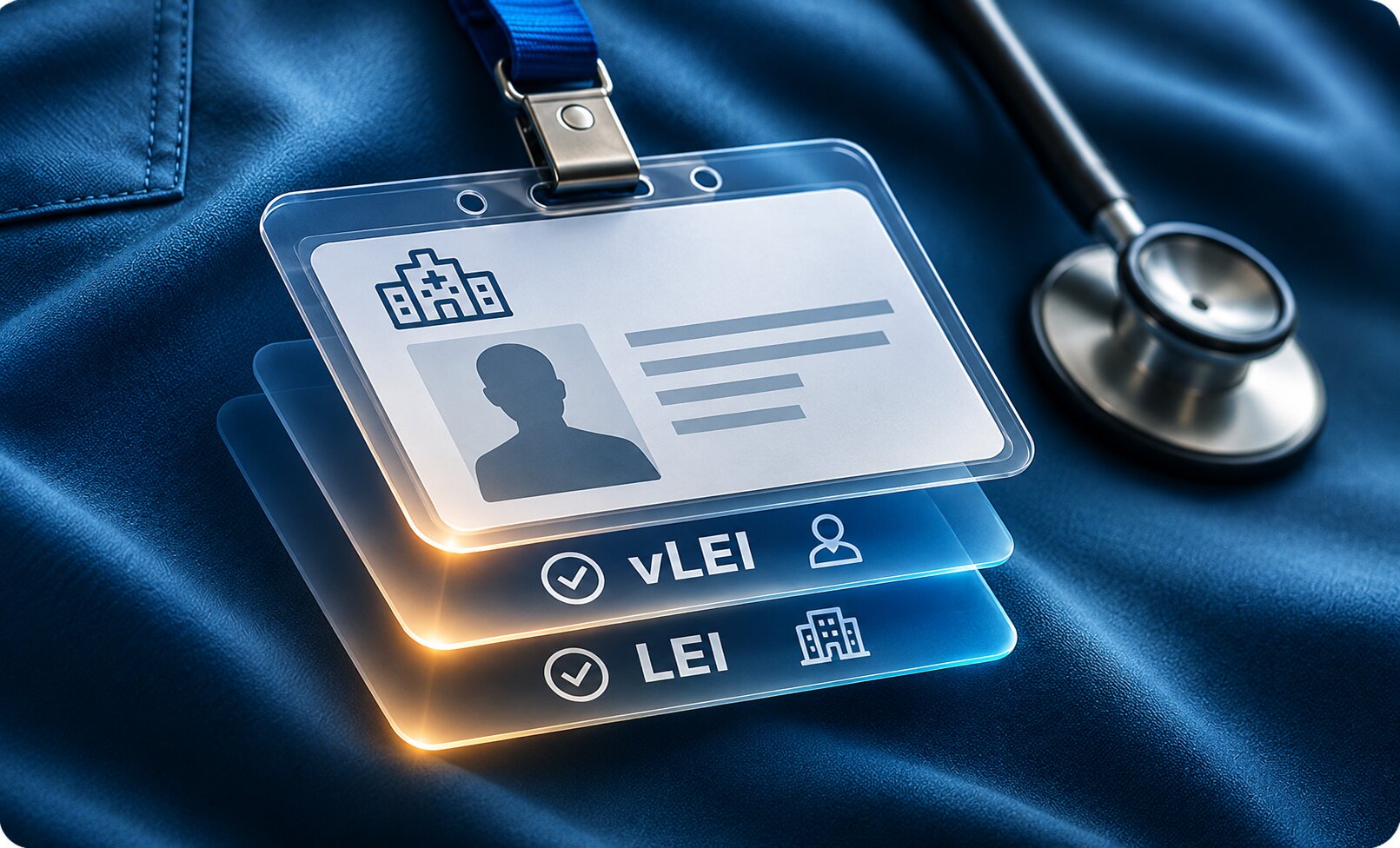
Kristian Hein, November 2
GLEIF and DirectTrust are developing a new digital trust model for US healthcare using LEI and vLEI. The initiative aims to help hospitals, laboratories, insurers, and other organizations verify identities, confirm delegated authority, and establish trust across digital systems. It marks an important step toward expanding the use of LEI beyond financial services.
Read more








 Affordable
 Lapse Guard
 Auto Renewals
 $69 total