


Every Size, Not Just Large Institutions
A small business being onboarded by a bank needs a verifiable LEI as much as a large corporate client. Firms of every size are in scope on both sides of a KYB check.

Select Your Jurisdiction
Currently selected: Cayman Islands|

Search region…
Know Your Business processes are only as reliable as the entity data behind them, and company names, local registration numbers and manual registry lookups create exactly the inconsistencies KYB is supposed to catch. The LEI replaces that fragmented approach with one GLEIF-verified identifier that resolves to authoritative legal name, address and ownership data anywhere in the world. LEI System registers and manages the LEI codes that anchor KYB, KYC and AML workflows, backed by GLEIF accreditation and a 150-jurisdiction reach.


LEI System is an official LEI Registration Agent
Latest LEIs issued:
984500F4100AB5956011 |  QUINNCOM INTERNATIONAL PTY LTD
The requirement reaches every entity being verified, and
relevance has nothing to do with company size.
A small business being onboarded by a bank needs a verifiable LEI as much as a large corporate client. Firms of every size are in scope on both sides of a KYB check.
Compliance technology providers use LEI reference data as a verified data source, replacing fragmented manual lookups with one standardized identifier.
Banks and financial institutions use LEI-anchored data to verify new corporate clients faster, with less manual registry work per onboarding.
Compliance teams use LEI Level 1 and Level 2 data to verify identity and ownership in ongoing AML monitoring, including AMLR beneficial-ownership checks.
Companies holding an LEI make their own onboarding faster, since a verified identifier lets a counterparty confirm their identity in seconds instead of requesting documents.
Fragmented data is the reason to build KYB around the LEI. These are the operational problems it solves along the way.
| Problem | How the LEI Solves It |
|---|---|
| Company names and local registration numbers don't align across jurisdictions | One LEI resolves to one verified record, recognized the same way everywhere |
| Manual registry lookups slow down every new client onboarding | One LEI lookup returns verified legal name, address and status instantly |
| Sanctions screening generates false positives from name-variation noise | A standardized identifier removes the ambiguity screening systems misread as risk |
| Beneficial ownership behind a corporate client is hard to trace manually | LEI Level 2 data resolves direct and ultimate parent ownership in one lookup |
| KYB data quality varies depending on which jurisdiction a client is registered in | GLEIF's corroboration process verifies records against authoritative registries globally |
Beyond the theory, this is where the LEI actually gets used day to day.
Look up a new client's LEI to pull verified legal name, address and registration status directly from GLEIF at the point of intake.
Use LEI Level 2 data to map a client's direct and ultimate parent ownership as part of beneficial-ownership due diligence.
Screen a corporate client's LEI-verified legal name against sanctions lists, cutting the false positives free-text name matching produces.
Periodically re-check a client's LEI status to catch a lapsed identifier or a data change flagged through GLEIF's corroboration process.
Verify a client registered in an unfamiliar jurisdiction through their LEI record instead of researching that country's specific business registry from scratch.
KYB has traditionally relied on whatever identifier a client happened to provide, a company name, a local registration number, sometimes both, none of which are consistent across jurisdictions or verifiable without a separate registry lookup.
The LEI was built to be entity-identification infrastructure rather than a jurisdiction-specific number, which is exactly the gap KYB has needed filled: one identifier, one verification standard, one authoritative source of legal name, address and ownership data regardless of where the entity is registered.
Integrating the LEI into a KYB workflow delivers measurable operational benefits, not just a compliance checkbox.
Integrating the LEI into a KYB workflow delivers measurable operational benefits, not just a compliance checkbox.
When a client provides their LEI at onboarding, verified identity and ownership data is retrieved from GLEIF instantly, no manual registry lookup required.
A verified LEI eliminates name-variation ambiguity in automated screening, reducing the flagged-but-legitimate transactions a compliance team has to manually clear.
Because the LEI is the only globally standardized organization identifier, using it as the KYB anchor keeps data quality consistent no matter which jurisdiction a client is registered in.
The GLEIF Global LEI Index contains two layers of reference data that map directly onto what a KYB check needs to establish.
Level 1 data provides an entity's official legal name, registered address, country of formation and current registration status, verified against authoritative national registries.
Level 2 data maps direct and ultimate parent ownership globally, the core data beneficial ownership analysis and group-structure mapping depend on, including the kind AMLR's beneficial-ownership transparency requirements for legal entities and trusts are built around.
Every LEI record carries a corroboration level showing how thoroughly it's been verified, fully corroborated records offer the highest confidence for a KYB decision.
| Data Layer | What It Contains | KYB Use |
|---|---|---|
| Level 1 | Legal name, address, formation country, registration status | Instant identity verification at onboarding |
| Level 2 | Direct and ultimate parent ownership | Beneficial ownership and group-structure analysis |
| Corroboration Level | Verification confidence rating | Assessing data reliability for a compliance decision |
Individual lookups work for occasional checks. Platforms running onboarding at scale rarely stop there, client portfolios need identifiers registered, tracked and renewed continuously.
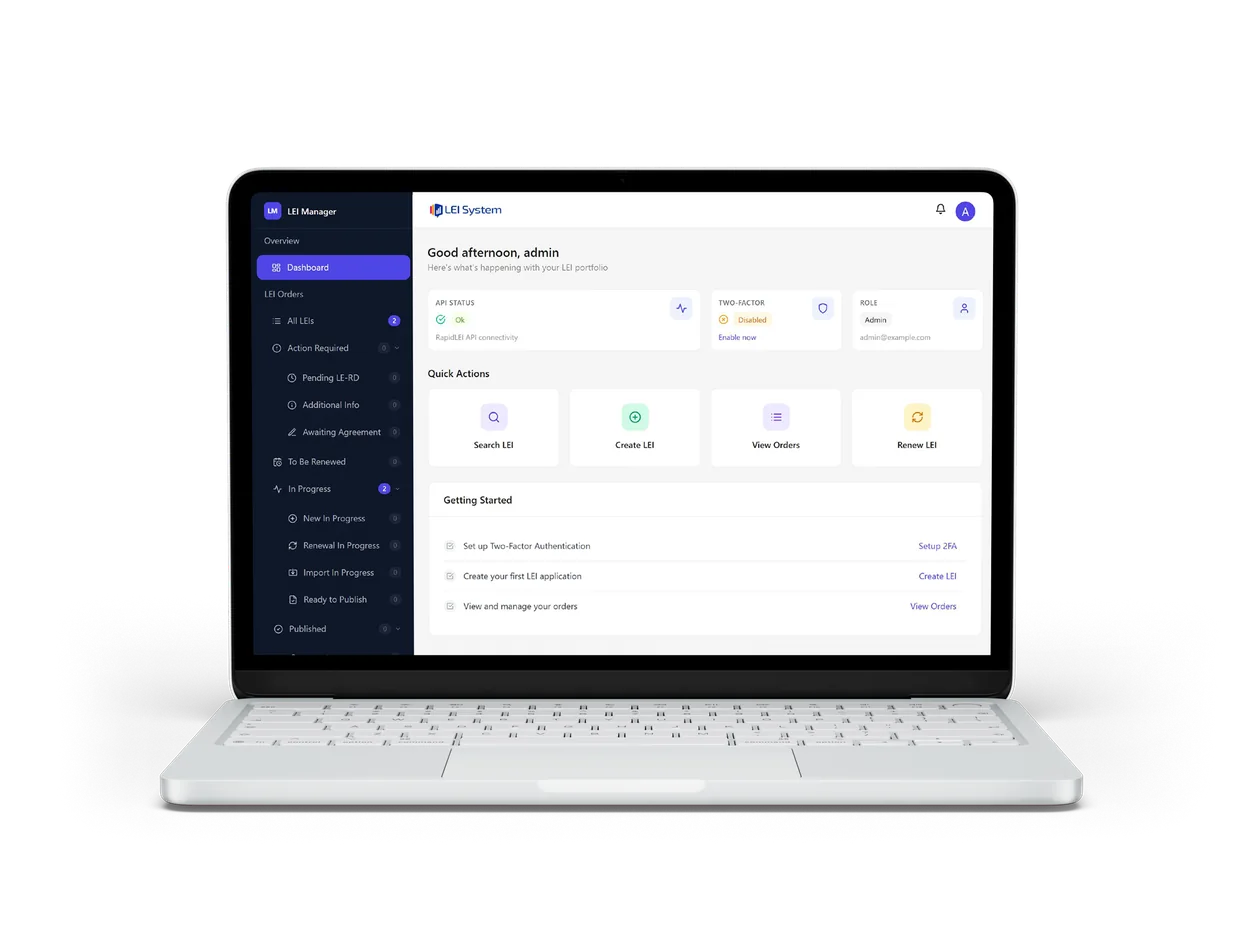
LEI Manager is LEI System's platform for exactly that.
Explore LEI ManagerEmbed LEI registration and GLEIF data lookup directly into an onboarding platform via the LEI Manager API, making entity verification an automated step in every client intake.
Track LEI status, renewal dates and data accuracy for an entire client portfolio from one dashboard, with automated alerts to prevent lapsed identifiers.
Register LEI codes for multiple client entities simultaneously, without engaging the issuing process separately for each one.
Getting registered is a five-minute online process, not a paperwork exercise. Submit your entity's legal name and registration details, LEI System verifies them against official business registries, and your code is issued and published to the GLEIF Global LEI Index, immediately checkable by any counterparty or regulator who looks it up.

Pick a subscription plan and complete the online application with your entity's legal name, address and registration number.


Our system verifies your entity data against official business registries in real time, notifying if additional documents are needed.

Your LEI code is issued, recorded in the Global LEI Index and delivered to your email address along with a confirmation.
Every LEI System plan includes the GLEIF fee, lapse protection, and automatic annual renewal, so a code stays in ISSUED status for every transaction it is used in, not just the first one.

Kristian Hein, November 18
The Financial Stability Board’s 2026 cross-border payments report highlights the UK’s CHAPS system as a live example of how Legal Entity Identifiers are moving into payment infrastructure. CHAPS handles everything from time-sensitive business and property payments to large financial-market settlements. Its financial-institution layer carries 73% of the value settled, making LEI data especially relevant for risk management, compliance, counterparty identification, and automated processing.
Read more
Kristian Hein, November 11
Does a branch need its own LEI, or should it use the head office’s code? Opening a foreign branch does not automatically create a separate LEI requirement. This guide explains the difference between branches and subsidiaries, when reporting rules call for the head office’s LEI, and when a branch may need its own. Find out what to check with your bank, broker or supervisory authority before applying.
Read more
Kristian Hein, November 2
GLEIF and DirectTrust are developing a new digital trust model for US healthcare using LEI and vLEI. The initiative aims to help hospitals, laboratories, insurers, and other organizations verify identities, confirm delegated authority, and establish trust across digital systems. It marks an important step toward expanding the use of LEI beyond financial services.
Read more








 Affordable
 Lapse Guard
 Auto Renewals
 $69 total